Most hunters spend the season hoping a buck wanders past their stand. But what if you could pull him in on purpose, and know he’s coming before he ever steps out in daylight? That’s the whole idea behind a mock scrape. Longtime Exmark ambassador and veteran outdoorsman Joe Thomas has been building them on his own property for years to attract and pattern bucks through the breeding season. In his latest Backyard Life video, he shows exactly how to make a mock scrape, turning a quiet spot into a scrape zone. The best part? You can pull it off with gear you already own.
Why Scrapes Work During the Rut
To build a convincing mock scrape, it helps to understand what a real one does. As the whitetail rut ramps up, bucks establish and advertise their territory through a series of ground scrapes, which are bare patches of dirt they paw out and mark with scent. Hanging above almost every scrape is a licking branch: a limb the buck works over with his eyes and forehead. Bucks will even rise up on their hind legs to rub that branch against the orbital gland near the eye, leaving behind a distinct scent profile that other deer read like a note tacked to a community board.
Put fresh dirt and a worked-over branch together and you’ve got yourself a communication hub. Recreate it convincingly, and you give every buck in the area a reason to stop and check in, right where you want him.
Step 1: Cut the Opening
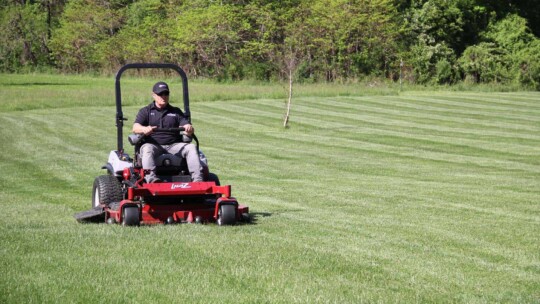
Joe kicks things off with his Exmark Lazer Z zero-turn mower, cutting an opening in a brushy stretch of field near a tree line. Whenever possible, he sets it up in a corner. Corners work like natural travel funnels, so bucks tend to approach from different directions. That gives you more chances to catch one on camera and flexibility to play the wind. A clean, mowed opening also makes the spot more visible and inviting, giving you more space to work.
Step 2: Build the Licking Branch
With the opening cleared, the next step is creating the licking branch. Joe does this by hinge cutting or gently bending an overhanging branch down to about four to five feet off the ground, right at a buck’s eye level. Sometimes he gets lucky and finds a limb with a natural lean to it. When he doesn’t, he’ll tie a rope around the branch, pull it down, and anchor it off until it sits at the right height.
Step 3: Jumpstart the Action
Joe roughs up and breaks off the ends of the licking branch, so it looks like deer have already been working it. That little bit of visual proof tells passing bucks the spot is active and worth investigating. It sounds crazy, but a branch that looks used draws far more attention than one that looks untouched. An old-timer showed Joe this trick a long time ago, and it still pays off.
Step 4: Kick Out the Mock Scrape
Right under the branch, Joe kicks out a patch of bare dirt to get the scrape itself started. You’d be surprised how much that fresh, turned-up soil smell pulls a buck in and holds him there. This is the ground-level half of the equation: the dirt and the branch working together to mimic a natural scrape compels a buck to come freshen up himself.
Step 5: Hang a Trail Cam
The last piece of the puzzle is a trail camera. Once the scrape is set, a cam over the spot tells you exactly what’s showing up and when. If a buck you want to target starts hitting the scrape, you’ve got the intel you need to move in.
The Big Picture
A mock scrape is one of the most effective, low-cost tools a whitetail hunter can build. A mower to cut the opening, a branch pulled to the right height, a handful of kicked-up dirt, and a trail cam are all it takes to turn a quiet field corner into a buck’s regular stop. Put in the work now, and you set yourself up to tag that big buck when the season’s on the line.
Frequently Asked Questions About Making a Mock Scrape
The pre-rut window, generally October into early November across much of whitetail country, is prime time, since that’s when bucks are most active on scrapes and establishing territory. That said, getting your scrape set up a little early gives deer time to find it and start working it, so it’s producing intel when the rut kicks into gear.
Aim for roughly four to five feet off the ground, about the eye level of a mature buck. If a branch sits too high, deer can’t work it with their forehead and orbital gland; too low and it won’t get used naturally. If nothing hangs at the right height on its own, tie a rope around a nearby limb, pull it down, and anchor it in place.
Field corners and edges near a tree line are ideal. Corners act as natural travel funnels, drawing bucks in from multiple directions and giving you better options for camera placement and wind. Look for a spot with a usable overhanging branch, decent cover nearby, and a clean approach for slipping in and out without spooking deer.
You don’t have to run one, but a trail cam is what turns a mock scrape from an attractant into a scouting tool. It shows you which bucks are using the scrape and when, so you can decide whether a buck is worth targeting and time your hunt around his patterns instead of guessing.